The key to performance is knowledge. The key to knowledge is track time. The key to track time is PRACTICE. We used to be in a kart as often as we could be….now it seems nobody practices! Find a CHEAP local track (a dying breed, I know…) and get SEAT TIME. Experiment with lines, experiment with setups, experiment with gearing options…etc. Before beating other racers, you must first beat the track…seat time.
5 Likes
Totally agree. Local club is Kelly’s Motorsports Park. Old school track. You got a set the karts up different than a big track to be fast.
Per seat time.. I have been lacking… mid twenties suck I wish I was in college again and had all the time in the world
this big on this hitting up local club events and traveling that way is way more fun then paying craps loads to do a series that essentially in some cases draws less of a crowd. I’d rather racce senior as Badger or Norway in Briggs vs paying to run a series that gets half the entries is is at times far too serious. one set of tires between those track and a set between 61 and Midstate. more bang for my buck
2 Likes
Exactly what I did for GLSS…. I bought I used set of Mojo D2s and was just as competitive as everyone else.
1 Like
Badger had some complaints that the Sr Medium class was getting too big. My response was, Are you serious?? They tried to push a Senior light class.
My response to that was, all you’re doing is eliminating track time by adding another class. Most of those Senior light drivers are still going to drive senior medium.
It is a hard reality in this sport. I know we lost a few national races at my local track. I have also noticed that our local track is shifting away from drivers and races and catering more to rentals and turnkey races. I am not sure if this is because of profit or what.
2 Likes
I was doing some analysis and wanted to share a couple different perspectives.
I think the general state of the sport is more extreme than ever. It seems like club level participation is relatively low, with (anecdotally) club level participation only being used a training ground/stepping stone to prepare for larger events. Even then, it seems like lately the happiness of racers is so tied to the result that they’ve forgotten that having a battle is a great part of it, regardless of whether you come out on top. Parents are spending fortunes to try to be at the front of the swift and KA junior categories.
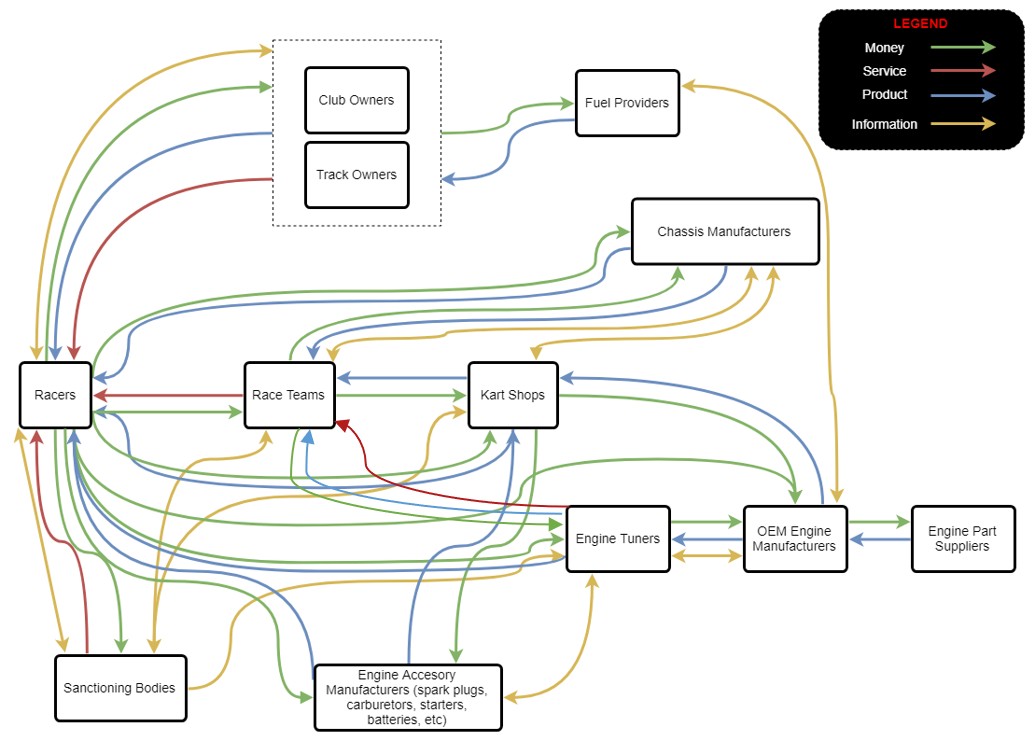
I mapped out the karting ecosystem (far from totally complete, but good enough) and you can imagine what happens when people start spending too much money with race teams. They end up basically controlling the supply of karts from the chassis manufacturers, buy up all the motors from engine builders, just generally speaking they have too much control over the whole ecosystem. It trickles down to the club level in unintended and unfortunate ways.
One example is that it seems like the used kart market is absolute garbage. These days you’re basically forced to sell your 1-2 race old chassis for pennies on the dollar, simply because there are no buyers. Prospective club racers are perfectly fine buying a 4-5 year old kart for considerably less, and racers that are looking to get into the regional/national scene look to the race teams to rent a chassis for the events they participate in. Furthermore, the teams have a supply of used karts that they are willing to sell for cheap since they are making most of their money from their services, which strengthens their chokehold. Teams basically have a stranglehold on most of the market in the US, from my perspective - I am not sure if that differs globally.
Additionally, there are outside market factors that are completely out of the karting industry control. Everybody has heard about how incredibly expensive data centers are and how much is being spent, but visualizing it always helps. From my research, it seems like the global karting market is about $150M. In the image below, that is the tiny green square. The larger blue square is the capital expenditure for just 1 data center. The red blob is Nvidia’s projected data center revenue for just 2025 - nevermind that their market cap was pretty close to $5 trillion recently.

Another way to put it - for most data centers, they would likely spend more on just the cabling/wiring than they would on buying the land/track to build the center itself. These gigantic forces could literally buy the entire karting industry and not even feel it.
There’s not a ton any singular one of us can do about these things, but there are of course some basic things we can do to help support the sport we love. It sounds repetitive and maybe stupid but supporting your local club, shops, etc is more important than ever. Yes, you might save $10 buying from Mondokart (even with the tariffs), but with every one of those purchases you’re killing the local scene. Without your local support, the only entities that will continue to exist will be the biggest “players”. Without grassroots support for the sport, it is hard for it to be sustainable.
2 Likes
Team forcing their drivers to constantly get new chassis seems to be an issue. Is there really that much fall off after a few weekends?
No! x 1,000,000,000
The teams with the half-a-million-dollar setups didn’t get there from simply offering arrive-and-drives… Selling each driver 5 karts a year certainly helps.
1 Like
Depends what you run… a chassis with a 1.6 mm pipe can be completely wasted after 4-5 days in a track such as Muro Leccese in Italy, GoPro Motorplex , New Castle in US or any other places where you need to be aggressive on the curb.
I’ll just stick to our OTK running it Neutral and fast! lol
2 Likes
1.6 mm are not commercial frame. You are in a 2.0 mm and FE material 99,9%. You can sleep well at night 
1 Like
It shouldn’t, though to be honest, seeing how drivers “abuse” the chassis on a national race weekend it’s something else. Another reason I think it’s that some drivers get accostumed to the feeling of a new chasis so when they run with a used one they feel uncomfortable and sometimes get crazy.
I always thought the chassis thing was to spread the complete cost out over a few weekends of national racing and always end up with brand new stuff. Ex - buy a new chassis for 3k and sell it for 2k after 2 weekends. At the end of 6 weekends you have spent the same amount and never had a chassis over two weekends old.
1 Like
Except that new chassis are closer to $5/6,000.
Then used after a few national races are $3500.
That $3500 number is also very dependent on if you have enough buyers local to you, which is a struggle in some regions.
Current TAG chassis prices from my research:
Sodi: $6600
Compkart: $6800
OTK: ~$6000
Birel: $5545
Hard to tell if those are actually the real prices too, or whether youll get slapped with a tariff charge on top of that.
We buy from teams for our chassis, getting like-new chassis for half (or less) retail. It gives them an outlet, and gives us savings. I agree that it erodes the used market some, but there’s hardly a used market anymore. Most are teams. Or 15 year old ‘worthless’ chassis. (I enjoy rebuilding those, and frankly, most are still competitive for club level.)
I have formulated an idea for the Association of Recreational Karters (ARK) ™ that focuses on the lifelong karter with only a handful of classes, focus on longevity and affordability. Options will be ‘open’ where possible to discourage monopolies and encourage resourcefulness. There will be no ‘ladder’ except lifelong enjoyment of the sport. A sister company – the Association of Professional Karters (APK) ™ would align with FIA classes and have cash payouts, etc. but cost MUCH more to participate in. Both would have true licensing. Both would have sprint, enduro, and superkarts. I am close enough to pulling the trigger on this that I’ve already started gathering info on venues and pricing… But my model would be a franchise-type club format, with a unique take I don’t think anyone’s done yet. Once I flesh it out a bit, I may post here for input.
The sport, as most of motorsports today, is in a sad state.
1 Like
I’ve been in karting for 10 years. Started off as a dad who had to take his kid’s kart to FMS to move the seat and pedals. Over the years, I got better with the wrenching and became very involved in our club. Last year, our numbers where almost double from when we first started. I don’t have access to that info this year, as I am no longer on our BOD. I would say our club scene is very healthy and extremely competitive.
Our club has been around for over 65 years, and our goal is always to keep it affordable. We only raise fees if we see a cost increase, or if we are planning for a large improvement to the facility. We don’t have an owner, so there is no intent to make large profits.
I have limited experience with regional racing. We have ran Rte66 a few times. I think the numbers start to decrease as more regional series have popped up, and the overall cost of living has increased to the point that some can no longer afford it.
I have no experience with national series, as we don’t have the budget, and would likely not be very competitive.
IMO, they way to keep karting alive and healthy is to focus on club racing. It’s the foundation of this sport, and likely where 99% of regional and national karters get there start. I would also bet that club karters outnumber national karters 10:1
Keep your club affordable! Keep it fair (good tech and race officials)! And number 1, keep your club fun! Cookouts, ice cream socials, fun races, etc. Most karters are there for fun, knowing they may never win a race, or move onto the next level of karting.
10 Likes
We (and many others) paid $253 for a Friday practice this weekend for one driver and one mechanic. Regional racing.
That is a LOT for regional event, in EU we are never over the 65-75€.
Thursday practice at World Championship was 175€ with 4 session of 15 mins each (quite long tbh)
1 Like